
Table of Contents
- How much traffic do I need to optimize my website?
- Optimize page load time
- Optimization tasks with low traffic
- Heuristic analysis
- Analytics audit
- Analytics events
- Conversion funnel analysis
- A/B testing: Micro-conversions
- A/B testing: Test radical things
How much traffic do I need to optimize my website?
If you truly want to run a continuous optimization campaign with several A/B tests per month, you will need 100,000+ visits/month.
From that traffic level onwards, you should be dedicating a monthly investment (in tools and team) to conversion optimization; you will get interesting results and improve your performance.
As an example, for a test with 2 versions where the conversion rate is 3% and you want to improve by 20% (going from 3% to 3.6% conversion rate) with 95% confidence:
- Duration of 26 days if you have 1,000 visits per day.
- Duration of 8 days if you have 3,300 visits per day.
 26 days with 1,000 visits/day
Source: https://vwo.com/tools/ab-test-duration-calculator/
26 days with 1,000 visits/day
Source: https://vwo.com/tools/ab-test-duration-calculator/  8 days with 3,300 visits/day
Source: https://vwo.com/tools/ab-test-duration-calculator/
8 days with 3,300 visits/day
Source: https://vwo.com/tools/ab-test-duration-calculator/
But don’t worry if you don’t have much traffic to your website; you can still optimize your conversion rate…
Optimize page load time
According to Google, a half-second delay could cause a 20% drop in traffic.
From Google’s perspective, pages that take too long to load will prevent search engine bots from crawling as many pages, making it harder for Google to crawl effectively. This could have a negative impact on your website’s organic performance.
In addition, Google’s algorithm officially takes into account overall website speed and page load time, making page speed optimization vital if you want a chance at ranking higher in the SERPs (Google results).
In conclusion, optimizing your web page load times will allow you to improve conversion rate, SEO, and user satisfaction.
Optimization tasks with low traffic
Optimization depends on people, not just data; if the data isn’t there, people will give you important data: start with qualitative research. You can always conduct user testing, heuristic analysis, and customer interviews, even if you have no traffic.
User testing
User testing allows you to see and hear how real people who represent your target audience interact with your website and comment on their thought process out loud.
The idea is simple: observe how real people use and interact with your website while commenting on their thought process out loud. You will pay attention to what they say and experience.
User testing gives you direct information about how real users use your website. You may have designed what you believe is the best user experience in the world; but watching real people interact with your site is often a humbling experience. Because you are not your user.
You can do this in person or remotely. When doing it in person, make sure to film everything. Doing it remotely using online user testing tools is definitely the cheapest and fastest way to do it.
Heatmaps / Click maps
A heatmap is a graphical representation that uses a color-coding system to represent different values. Heatmaps are used in various forms of analysis, but are most commonly used to show user behavior on specific web pages.
 Heatmap with Hotjar
Thanks to tools like Hotjar, you can start collecting data on your users’ behavior. Hotjar offers a free plan covering up to 35 sessions per day, making it accessible even if you are just starting out and still have low traffic.
 Click map in Hotjar.
Don’t forget to analyze heatmaps and click maps, as well as session recordings, for both desktop and mobile traffic.
If you are looking for a free alternative with no session limits, Microsoft Clarity is an excellent option for low-traffic sites. It offers session recordings, heatmaps, and behavioral analytics completely free of charge and without volume restrictions — ideal when every visit counts.
For more information on how to analyze heatmaps, there is an excellent article on Hubspot.
Surveys
Try to get responses from your visitors, either while they are browsing or when they are about to leave, with a simple question to understand their doubts and identify friction points you may have missed.
A survey sent to your customers after conversion, allowing them to rate their experience, will reveal anything that could be improved or reinforced.
 Question
Heuristic analysis
Heuristic analysis is an analysis of your site and tools based on expert assessment and an analysis of the experience from the perspective of industry norms and best practices. This type of approach uses, among other things, usability concepts such as those presented by Jakob Nielsen:
- Visibility of system status (where am I on the site?)
- Match between system and the real world
- User control and freedom
- Consistency and standards
- Error prevention
- Recognition rather than recall
- Flexibility and efficiency of use
- Aesthetic and minimalist design
- Help users recognize, diagnose, and recover from errors
- Help and documentation
Analytics audit
An audit of your Google Analytics account is usually the first step needed to improve your organization’s analytical maturity. If you can’t trust your data, you won’t be able to make decisions.
It is key to dedicate time and resources to your analytics audit; on our blog we have an article about Google Analytics Audit in 45 steps
Conducting a Google Analytics audit will allow you to answer several questions:
- Does my account collect the data I need?
- Can I trust the data that Google Analytics presents to me?
- What are the configuration errors?
- Are there elements that could be improved?
- What reports do I need?
Data analysis work is based on trust in the data. Google Analytics aims to guide action and plays an important role in decision-making. Data must be reliable and secure.
The main goal of auditing your Google Analytics account is to help ensure data integrity and quality. Fixing what is causing problems, improving what can be improved.
Analytics events
If you haven’t done so yet, it is highly recommended to create custom events with Google Analytics (or even better with Tag Manager).
By default your Analytics account does not offer you the ability to track events such as clicks on outbound links, forms, clicks on share buttons, and other events specific to your website.
Getting data on these events will allow you to know the actions your users take; whether buyers click on your size information link, whether non-buyers sign up for your newsletter or visit certain links.
 Custom Google Analytics event with Tag Manager
Conversion funnel analysis
Carry out an analysis of your funnel: where do your visitors drop off?
A conversion funnel is an idea or a way of visualizing and understanding the flow and conversion of prospects into buying customers.
These visitors can be generated through a variety of methods such as SEO, content marketing, social media marketing, paid ads, and even other methods.
If you can understand and analyze the process, you can take steps to improve that flow.
 Source: https://thinkstrategy.com/
This is a very simple visualization showing the four main steps of the process:
First, your potential customer becomes aware of your existence or your product. (Awareness)
Second, you generate interest in your product. Note that the funnel becomes smaller because not everyone who knows about your product will be interested. (Interest)
Third, you must plant the seed of desire for your product or service. Again, the funnel becomes smaller because you can’t expect everyone who is interested to actually desire your product. (Desire)
And finally, you ask for an action. For example, the action could be to buy something or subscribe to an email list. This is the smallest part of the funnel because only a small percentage of the original prospects will take action. (Action)
Many argue that the real-life conversion funnel can never be that linear (https://www.crazyegg.com/blog/traditional-sales-is-funnel-broken/). However, from a conversion optimization perspective with low traffic, it is a method that can help you.
 According to Comscore, users do not have as linear a journey as the classic funnel model claims.
A/B testing: Micro-conversions
What is a micro-conversion?
A micro-conversion is a small step in a visitor’s journey toward their main conversion goal (usually called a macro-conversion). For most websites, these macro-conversions are a purchase.
The closer to the start of the conversion funnel your test begins, the larger the number of users and, in general, the higher the conversion rate, which will help the performance of the test.
Optimization with low traffic consists of finding those important micro-conversions and improving them.
“Add to cart” is an example of a micro-conversion, compared to “Proceed to checkout,” which is a macro-conversion and one of the main business objectives of the website.
Typically, you will get many more clicks on the “Add to cart” button than actual purchases, which will allow you to run more meaningful tests more quickly.
It is true that adding an item to the cart is not the same as a purchase, but by optimizing this step in the buying process, you increase the likelihood of a positive impact on your final sales conversion.
A/B testing: Test radical things
If you have low traffic, you need to run high-impact A/B tests (radical changes).
Running an A/B test with a slight text change (see example) is not recommended when you don’t have tens of thousands of visits.
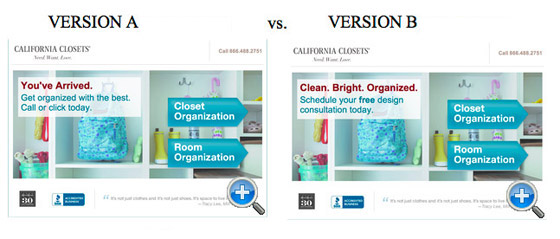
For an A/B test to give you useful results in less time, you will need to test very different things. Change the page structure, the main colors, the amount of text and images — change what seems important and what is very different from the original.

As you can see, there are numerous very interesting and effective tasks for getting started with optimization on low traffic.
Once you have more visitors, you will be able to run faster analyses and more numerous tests. Never stop improving.
Sources
- A/B test duration calculator - VWO
- Why performance matters - Google Developers
- Hotjar - Heatmap and session recording tool
- How to analyze heatmaps - HubSpot
- Jakob Nielsen - Wikipedia
- Think Strategy
- Is the traditional sales funnel broken? - Crazy Egg
- US Cross-Platform Future in Focus 2017 - Comscore
- VWO - Conversion optimization platform