AI and Automation in Digital Advertising: Complete 2026 Guide
How to use AI automation in Google Ads and Meta Ads in 2026: ChatGPT for ad copy, Google Ads Scripts, automated rules, and generative AI for creatives. Practical workflows.
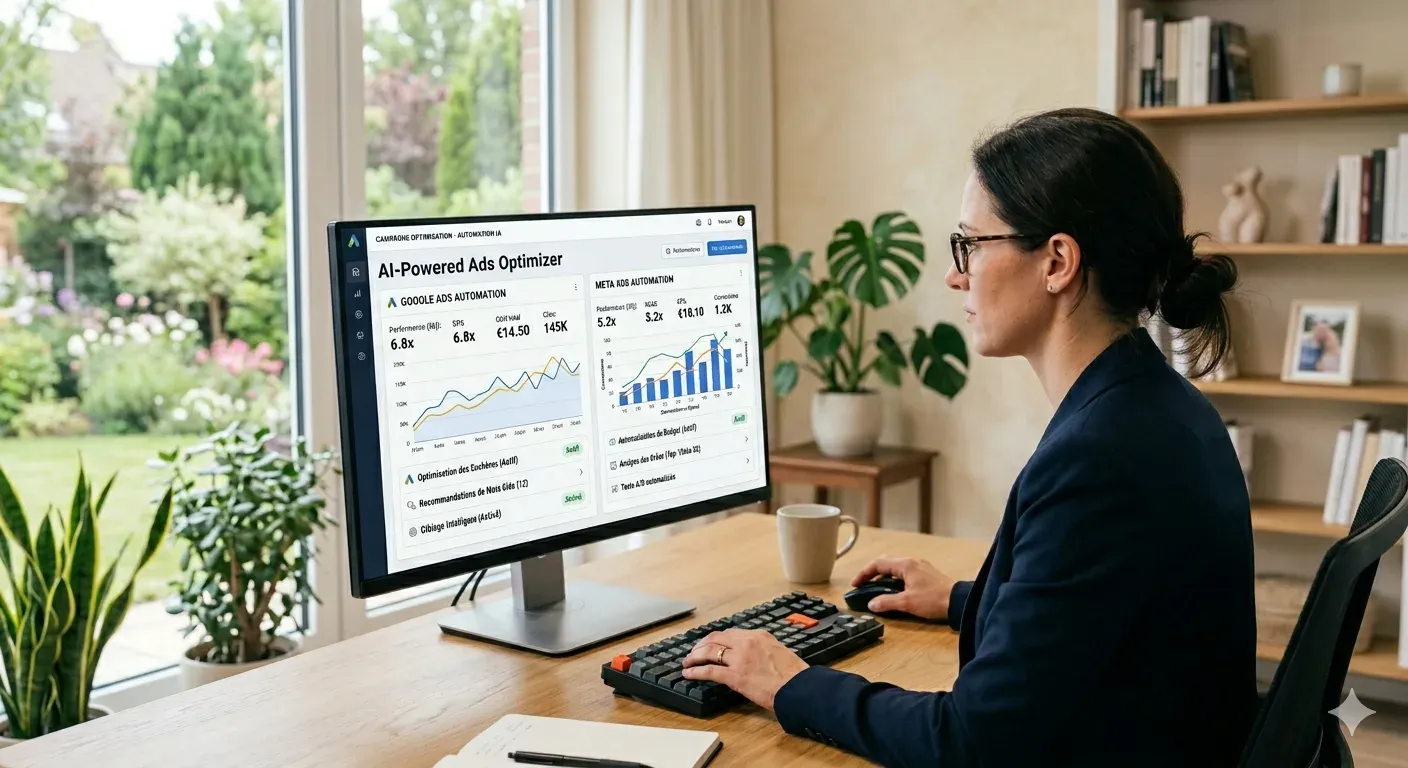
68% of marketing professionals already use AI in their campaigns, according to the Salesforce State of Marketing Report (2024). But there is an important nuance: most of them use it passively, accepting Google and Meta’s default settings without understanding what is happening underneath. Activating Smart Bidding without sufficient data or handing creatives over to AI without a clear strategy are ways of automating spend, not results.
This guide covers every layer of advertising automation, from bidding to creatives, scripts, and automated rules. The goal is to help you decide what to automate, when, and under what minimum conditions for it to actually work.
If you need hands-on help applying these tools, you can work with a Google Ads Consultant who understands both platforms.
Key Takeaways
- 68% of marketers already use AI in advertising, but most do so passively (Salesforce State of Marketing, 2024)
- Smart Bidding requires a minimum of 150 conversions/month for reliable tROAS results, not the 50 Google officially recommends (Smarter Ecommerce, 2024)
- Advantage+ Creative improved ROAS by an average of 22% in Meta campaigns (Meta Engineering Blog, 2024)
- Marketers who use AI for content tasks save an average of 2.5 hours per day (HubSpot State of Marketing, 2024)
- Automation does not replace strategy: bidding, targeting, and creatives still require human judgment to work well
Contents
- What does automating digital advertising actually mean in 2026?
- Smart Bidding in Google Ads: how it works and when to activate it
- Advantage+ in Meta Ads: the automation that changes everything
- ChatGPT and generative AI for creating better ads
- Google Ads Scripts: automate without knowing how to code
- Automated rules: the first step before scripts
- AI for ad creatives: tools and workflow
- What to automate and what to never delegate to AI
- How to measure the impact of automation on your campaigns
- Frequently Asked Questions
- Sources
What does automating digital advertising actually mean in 2026?
Automating advertising does not mean hitting a button and walking away. According to the Interactive Advertising Bureau (IAB), programmatic ad spend, which includes automated inventory buying, exceeded 91% of total display spend in the US in 2024. But programmatic and automated are not the same as efficient. Automation only works when there is clean data, well-defined goals, and a human monitoring the results.
There are three distinct layers of advertising automation. Understanding them separately is the starting point.
Layer 1 - Bidding and budget. This is the most mature layer. Google’s Smart Bidding and Meta’s budget optimization system adjust bids in real time using thousands of contextual signals: device, location, user browsing history, time of day. No account manager can do that manually at that scale. This layer has the greatest impact on cost per acquisition when the input data is correct.
Layer 2 - Targeting and delivery. Here the algorithm decides who sees each ad. Advantage+ Audience on Meta and Google’s smart audience segments use behavioral signals and creative content to infer the ideal user profile. Detailed manual targeting carries less and less weight: the system learns faster from first-party data than from constraints we impose on it.
Layer 3 - Creatives. This is the newest layer and the most debated. Meta generates image variations with Advantage+ Creative. Google creates text and visual assets with Asset Generation for Performance Max. Third-party tools like AdCreative.ai or Pencil generate complete creative concepts. This layer requires more human oversight than the other two.
Citation: Programmatic ad spend exceeded 91% of total display spend in the US in 2024, but strategic adoption of automation remains low: most advertisers activate automatic tools without setting up the minimum conditions for them to work. (IAB Internet Advertising Revenue Report, 2024)
Smart Bidding in Google Ads: how it works and when to activate it
Smart Bidding adjusts the bid at each auction using more than 70 million contextual signals in real time, according to the Google Ads Help Center (2024). Google recommends a minimum of 50 conversions/month to activate tROAS, but Smarter Ecommerce’s analysis of 14,000+ active campaigns shows that real reliability does not appear until 150 conversions/month.
The four Smart Bidding strategies and when to use each:
- Maximize Conversions: the first step after accumulating data with manual CPC. No cost target. Ideal for the initial learning phase.
- Maximize Conversion Value: for ecommerce with variable order values. The algorithm optimizes toward higher-value transactions.
- tCPA (Target CPA): when you know your maximum acceptable cost per acquisition and have 30+ conversions/month. Useful for lead generation.
- tROAS (Target ROAS): the most data-intensive strategy. Works when you have 150+ actual purchase conversions/month, clean tracking, and a target calibrated to your real historical ROAS, not the one you would like to have.
The learning phase lasts between 7 and 14 days. It resets with every significant change: tROAS adjustments of more than 20%, budget changes of more than 20%, or adding new ad groups. The practical rule is to batch changes together to trigger a single reset, not several.
For a detailed look at conversion thresholds, failure signals, and the correct transition sequence from manual bidding, the full guide on Smart Bidding in Google Ads covers every scenario with data from real campaigns.
Citation: Google Ads processes more than 70 million signals per auction in real time to adjust Smart Bidding bids, including device, location, browsing history, time of day, and query type. Manual bidding cannot replicate that speed or that scale. (Google Ads Help Center, 2024)
Advantage+ in Meta Ads: the automation that changes everything
Advantage+ is Meta’s automation suite for ad campaigns. Advertisers using Advantage+ Creative recorded an average 22% improvement in ROAS according to data from the Meta Engineering Blog (2024). There are three main components that work in very different ways, and it is worth keeping them distinct.
Advantage+ Shopping Campaigns (ASC). These are fully automated shopping campaigns. Meta manages targeting, creatives, and budget distribution. They are designed for ecommerce with an active product catalog. The system combines retargeting and prospecting audiences within the same campaign, without the advertiser controlling the split. The advantage is simplicity; the risk is losing visibility into which segment is actually driving conversions.
Advantage+ Creative. This is not a campaign type, it is an ad-level setting. Meta automatically modifies visual elements: it adds frames, adjusts aspect ratios, generates background variations, and adapts brightness and contrast for each placement. It works best with creatives that already have a solid baseline performance. Activating it on ads with no history does not give the system enough signal to optimize from.
Advantage+ Audience. This replaces detailed manual targeting. The system uses the user’s behavioral history and the ad’s creative content to infer the ideal audience. Basic exclusions, such as country and age, remain configurable. Specific interest segments carry less weight because Meta’s Andromeda engine can infer them with greater precision from the ad content itself.
The complete guide on Meta Ads for ecommerce explains how to structure campaigns in this automated environment. And if you want to understand the technical engine behind Advantage+, the article on Andromeda, Meta’s ad retrieval system, explains why creative has become the primary targeting mechanism.
ChatGPT and generative AI for creating better ads
Marketing professionals who use AI for content tasks save an average of 2.5 hours per day, according to the HubSpot State of Marketing (2024). Applied to advertising, that time translates into more tested variants, more detailed briefs, and shorter approval cycles, not less strategic creative work.
There are three concrete use cases where generative AI delivers real value in advertising:
Headline and copy variant generation. The process is specific: you give ChatGPT the product’s value proposition, the ideal customer’s pain point, the brand tone, and the platform’s character limit. The model returns 10 to 20 variants. You select the 3 or 4 that best capture the intent and include them in the ad as test variants. Do not ask for “a headline for my ad”: the more specific the prompt, the higher the quality of the output.
Creative briefs for designers or image generators. AI can structure a complete creative brief: ad objective, audience, main message, visual references, format, and call to action. This reduces friction between the marketing team and the design team, and ensures every piece has a clear purpose before going into production.
Copy A/B testing at scale. With a well-structured prompt you can generate in minutes the text variants needed for a multivariate test. Emotional angle vs. rational angle, headline with a number vs. without, direct CTA vs. benefit-led CTA. The AI does not decide which one performs best; the test does.
To see exactly how to structure prompts for Google and Meta ads, with real examples by format and platform, the article on how to use ChatGPT for advertising on Google and Meta Ads covers the full workflow step by step.
Google Ads Scripts: automate without knowing how to code
Alert and budget control scripts are the most widely used Google Ads Scripts among freelance and agency managers — they catch overspend before it compounds, pause low-quality keywords automatically, and push performance data to Google Sheets on a set schedule. The most useful scripts are pre-written and free; implementation requires only copying, pasting, and adjusting parameters. (WordStream, 2024)
Google Ads Scripts let you automate repetitive account management tasks using JavaScript, but most of the most useful ones are already written and freely available. According to WordStream (2024), alert and budget control scripts are the most widely used by freelance and agency managers, precisely because they reduce manual monitoring time without requiring advanced programming knowledge.
What can scripts do? These are the most common use cases:
- Budget alerts. The script checks daily spend and sends you an email if a campaign is about to exhaust its budget before 6 PM. Without a script, you find out after the overspend has already happened.
- Pause keywords with low Quality Score. You can set up a script that automatically pauses any keyword with a QS below 4 and no conversions in the past 30 days. Reduces spend on low-quality traffic without daily manual review.
- Bid adjustments by device or location. Scripts that automatically increase or decrease bids based on historical performance by device, time of day, or geographic area. More precise than periodic manual adjustments.
- Automated reports in Google Sheets. The script pulls data from the account and pushes it into a shared spreadsheet with the client every week. Eliminates the manual work of exporting and importing data.
Where to find pre-written scripts? The official Google Ads Scripts library, Optmyzr’s GitHub repositories, and Russell Savage’s Free Google Ads Scripts are the three resources most used by experienced account managers.
To see the most useful scripts with step-by-step installation instructions, the article on Google Ads Scripts for automation includes the 10 most practical scripts with code ready to copy and paste.
Automated rules: the first step before scripts
Automated rules are the most accessible form of automation in Google Ads and Meta Ads: they require no code, are configured from the interface, and act based on conditions you define. According to the Google Ads Help Center (2024), automated rules can be applied to campaigns, ad groups, ads, and keywords, with execution frequency ranging from every hour to once per week.
Most common use cases in Google Ads:
- Increase the daily budget on Fridays and Saturdays if the historical CPA on those days is better than the average.
- Pause campaigns outside business hours for businesses that only convert when staff are available.
- Activate or pause promotional ads on specific dates without doing it manually.
- Send alerts when CTR drops below a defined threshold per campaign.
In Meta Ads, automated rules work in an equivalent way. You can pause ad sets that exceed a CPM threshold, scale the budget of ad sets with ROAS above a target, or deactivate creatives with a frequency above 3 in the past 48 hours.
The key difference between rules and scripts is flexibility. Rules work with simple conditions of the “if X then Y” type. Scripts can cross multiple variables, access deeper historical data, and execute complex conditional logic. The practical rule: start with automated rules for the most common cases; when you need more sophisticated logic, move to scripts. For setup instructions and the most useful trigger conditions, the guide on automated rules in Google Ads and Meta Ads covers both platforms step by step.
AI for ad creatives: tools and workflow
Generative AI tools for ad creatives have matured considerably in 2025 and 2026. Meta reported that more than one million advertisers use its generative AI tools to produce more than 15 million ads per month (Meta Engineering Blog, 2024). The volume is already there; the strategic quality of what gets produced is another matter.
Meta Advantage+ Creative. Generates automatic image variations: it adjusts backgrounds, aspect ratios, colors, and overlaid text for each placement. It does not create creative concepts from scratch: it optimizes what you already give it. A strong original improves with Advantage+ Creative; a weak original stays weak.
Google Asset Generation for Performance Max. Generates ad text, headlines, and descriptions from your website content or a prompt. It is useful for accelerating the creation of the first asset block, but the generated text needs review. The algorithm optimizes for clickability, not necessarily for conversion or brand consistency.
Third-party tools. AdCreative.ai generates complete ad images with overlaid text from a basic brief. Pencil generates short video concepts for Meta and TikTok from existing assets. Both are useful for speeding up variant production in testing cycles; neither replaces a strategic creative concept defined by a professional.
The workflow that works in practice has three steps: first, the human defines the creative concept and the strategic angle; second, AI generates technical variants (sizes, formats, copy versions); third, the human reviews and selects before publishing. AI in the middle, not at the beginning or the end. For a deeper look at tools and the full production process, the guide on generative AI for ad creatives covers every layer from brief to launch.
What to automate and what to never delegate to AI
The question most avoided in articles about advertising automation is this: what should AI not do? The honest answer divides tasks into two groups, and the dividing line is not where most people think.
AI handles well the tasks where processing speed and data volume are the main advantage. Adjusting bids in real time across thousands of simultaneous auctions, distributing budget between creatives based on performance in the past 24 hours, detecting spend anomalies before they impact the monthly budget: all of that the algorithm does better than any human, faster and with fewer errors.
What should not be delegated to AI:
- Strategy. What problem your product solves, for whom, with what message, and at what point in the funnel. The algorithm optimizes within the parameters you define; it cannot define those parameters for you.
- The creative brief. AI generates variants from a brief. If the brief is poor, the variants are too. The strategic concept, the emotional angle, and the positioning are human work.
- Data interpretation. A high ROAS can mean the campaign is performing well or that you are optimizing toward a small pool of repeat buyers who would have purchased anyway. AI reports metrics; you decide what they mean and what to do with them.
- Budget decisions at critical moments. Product launches, stock clearances, brand crisis situations: these are moments where business context outweighs statistical signals. The algorithm does not know you have three days of inventory left.
The most common automation mistake I see in audits is activating Smart Bidding before having enough conversion data. Not because Smart Bidding is flawed, but because the system optimizes with what it has: if it has 15 conversions/month, it will make bidding decisions based on a statistically insignificant sample. The typical result is that spend concentrates in a narrow segment, impression share drops, and the advertiser concludes that “Smart Bidding doesn’t work in my industry.” The problem is not the algorithm; it is that it was activated without the minimum conditions in place.
The practical rule is simple: automate the execution, keep control of the strategy.
How to measure the impact of automation on your campaigns
Switching from manual bidding to Smart Bidding or activating Advantage+ will not produce results comparable with traditional metrics unless you set up measurement correctly. The ROAS you see in the platform dashboard does not measure the real impact of automation; it measures what the platform attributes to itself. Those are different things.
MER (Marketing Efficiency Ratio) vs. platform ROAS. MER is the most honest metric for measuring the overall effect of automation: it divides total ecommerce revenue by total advertising spend, without depending on the attribution windows of any platform. If you activated Advantage+ Shopping and MER went up, automation is contributing. If Meta’s ROAS went up but MER stayed flat or declined, Meta is attributing conversions that would have happened regardless.
Incrementality tests. These are the only way to know whether automation is generating additional real sales or simply recapturing existing demand. The basic test: pause spend in a geographic or audience segment for two weeks and measure the impact on sales. If sales do not drop, you were paying for something that was happening without advertising. Meta has its own conversion lift tool; you can also use third-party tools like Northbeam or Triple Whale for independent tests.
What to track when switching from manual to automated bidding. During the first four weeks after the switch, monitor daily: impression share, cost per conversion, conversion volume, and percentage of time in the learning phase. A temporary drop in conversion volume during the first 7 to 14 days is normal; that is the learning period. A drop that extends beyond three weeks indicates a problem with the input data or the configured objective.
Citation: The Marketing Efficiency Ratio (total revenue / total ad spend) is the most reliable metric for measuring the real impact of automation because it does not depend on the attribution windows of any platform. A high ROAS in the dashboard does not imply a high MER for the business. (Triple Whale, 2024)
Frequently Asked Questions
Do I need to know how to code to automate Google Ads?
No. Google Ads automated rules require no technical knowledge: they are configured from the interface with simple conditions like “if CPA exceeds X, pause the ad.” Scripts do use JavaScript, but the most useful ones are already written and available in the official Google Ads Scripts library. Copying, pasting, and adjusting the parameters is sufficient for the most common cases.
What is the minimum traffic I need for Smart Bidding?
Google recommends 50 conversions/month for tROAS and 30/month for tCPA (Google Ads Help Center, 2024). But Smarter Ecommerce’s analysis of 14,000+ campaigns shows that real tROAS reliability does not appear until 150 conversions/month. Below 60/month, use Maximize Conversions without a target until you cross that threshold. The more conversions the algorithm has to learn from, the more stable the results.
Is Advantage+ Shopping better than manual campaigns?
It depends on the context. Advantage+ Shopping simplifies management and can improve ROAS in accounts with large catalogs and abundant conversion data. But it sacrifices visibility into the split between retargeting and prospecting, and does not allow audience exclusions with the same granularity as a manual campaign. For ecommerce stores with fewer than 100 conversions/month, well-structured manual campaigns tend to deliver more predictable results. For large catalogs with a solid history, ASC can scale more efficiently.
Can AI replace an advertising consultant?
Not in 2026. AI handles tactical execution very well: bid adjustment, budget distribution, copy variant generation. What it does not do is interpret business context, design funnel strategy, detect attribution issues, or adapt campaigns to unforeseen competitive changes. An experienced consultant decides what to automate, with what configuration, and when to intervene manually. AI executes those decisions at scale.
Where should I start if I have never used automation in advertising?
The correct order has four steps. First, verify that tracking measures real conversions with revenue value (purchases, not generic contact forms). Second, set up basic automated rules: budget alerts and pausing ads with no conversions. Third, accumulate 30+ conversions with manual CPC before activating Smart Bidding. Fourth, activate Maximize Conversions without a target for two weeks before adding tROAS or tCPA. Skipping any of these steps multiplies the risk of spending the budget on the wrong signals.
Automate the Execution, Keep Control of the Strategy
Advertising automation in 2026 is not optional for ecommerce businesses with meaningful ad spend: Google and Meta’s algorithms are already the default delivery system. The question is not whether to use automation, but how to configure it so it optimizes toward your real goals rather than toward the metrics that suit the platform best.
The key points: Smart Bidding needs clean data and a minimum conversion threshold to function; Advantage+ Creative improves the performance of creatives that already work, it does not rescue those that fail; scripts and automated rules save monitoring time without requiring technical skills; and generative AI accelerates variant production but does not replace a strategic creative concept.
Independent measurement, using MER and incrementality tests, is what separates advertisers who know automation is working from those who simply trust that it is.
If you want to review your campaign automation setup or start implementing these layers in an orderly way, you can book a free consultation.
Need help implementing automation in your campaigns? I work directly in your account as a freelance Google Ads and Meta Ads consultant, with no intermediaries and direct access to your data.
Related articles:
- Everything you need to know about Andromeda, Meta Ads’ AI engine
- Google Ads Shopping campaign structure in 2026: practical guide
- Performance Max for ecommerce in 2026: definitive guide
Sources
- Salesforce State of Marketing Report 2024
- HubSpot State of Marketing 2024
- Google Ads Help Center - Smart Bidding
- Google Ads Help Center - Smart Bidding Requirements
- Google Ads Help Center - Automated Rules
- Meta Engineering Blog - Andromeda: Meta’s Scalable and Efficient Ad Retrieval System
- Smarter Ecommerce - Target ROAS in 14,000+ PMax Retail Campaigns
- IAB Internet Advertising Revenue Report 2024
- WordStream - Google Ads Scripts Guide
- Google Ads Scripts - Official Solution Library
- Triple Whale - Marketing Attribution and Incrementality
- Contents
- What does automating digital advertising actually mean in 2026?
- Smart Bidding in Google Ads: how it works and when to activate it
- Advantage+ in Meta Ads: the automation that changes everything
- ChatGPT and generative AI for creating better ads
- Google Ads Scripts: automate without knowing how to code
- Automated rules: the first step before scripts
- AI for ad creatives: tools and workflow
- What to automate and what to never delegate to AI
- How to measure the impact of automation on your campaigns
- Frequently Asked Questions
- Do I need to know how to code to automate Google Ads?
- What is the minimum traffic I need for Smart Bidding?
- Is Advantage+ Shopping better than manual campaigns?
- Can AI replace an advertising consultant?
- Where should I start if I have never used automation in advertising?
- Automate the Execution, Keep Control of the Strategy
- Sources

Could your ad campaigns
perform better?
30 minutes to review your situation and tell you exactly what I would change. No pitch, no sales proposal.