
Table of Contents
- Choose the right campaign objective
- Audience size matters
- Don’t forget A/B testing
- Refresh your ads
- The power of images and videos
- Understand audience segments
- Optimise your landing pages
- Optimise your campaigns by placement
Choose the right campaign objective
The objective is set at the very beginning of the campaign creation process. Before discussing objectives, it is important to understand the structure of a campaign:
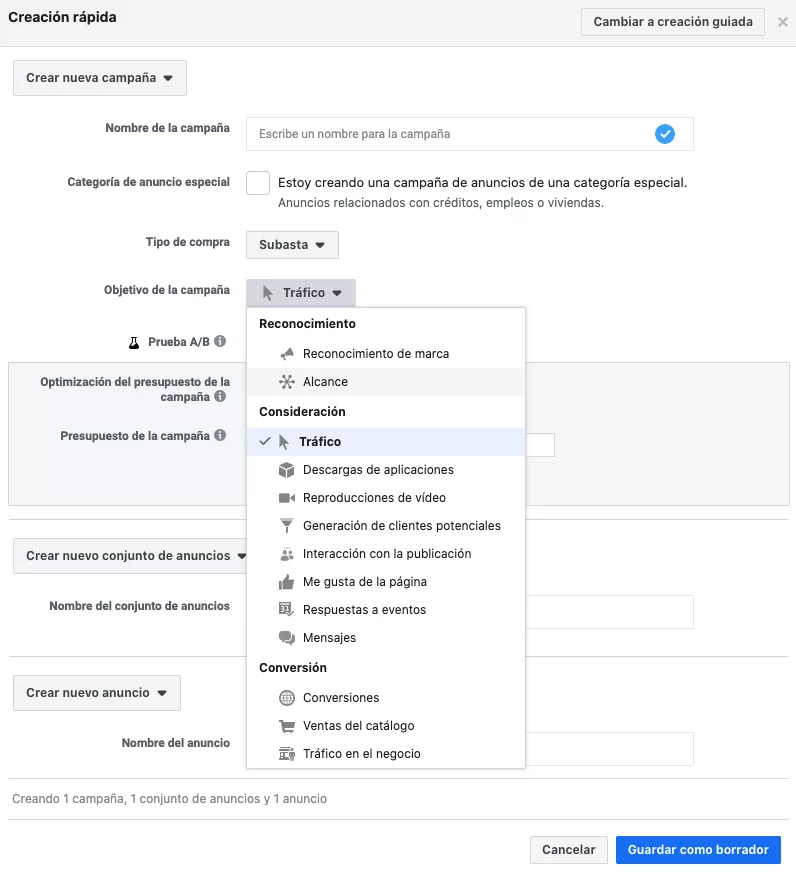
Campaign: The top-level element, where you choose your budget and your objective. Meta’s six current objectives are: awareness, traffic, engagement, leads, app promotion, and sales.
Ad sets: This is where you choose your audience, campaign duration, and ad placements. For each ad set, you can configure multiple ads.
Ads: This is what users will see!
The problem is that it is very easy to pick the wrong objective when creating your campaign — especially if you have limited experience in digital marketing.
Which objective should you choose?
The honest answer is: It depends.
To make more people aware of your business, you can use objectives such as “awareness”, “engagement”, or “video views”.
For example, the “awareness” objective (which encompasses the former “reach” and “brand awareness”) lets you reach the maximum number of people within your target audience. This is especially useful if you are doing local marketing.
The “engagement” objective lets you reach people who regularly interact with Facebook posts. This is particularly useful for boosting interactions with your ads and reducing costs.
Therefore, do not use this objective if you want to drive traffic to your website — there is a specific objective for that.
What if you want more leads or customers?
This is where many beginners go wrong and confuse the “sales” objective with the “traffic” objective.
We use the traffic objective to send visitors to a webpage. Nothing more. If you choose this option, Meta will optimise the delivery of your ads to find users most likely to click on the link in your ad.
In itself, the goal is to minimise your cost per click (CPC). We will come back to that.
The problem is that people who click will not necessarily be the ones who convert on your website. If your goal is to get conversions, there is a solution…
The sales objective lets you create ads that invite people to take a specific action on your website, such as making a purchase or signing up.
So, in which case should you use the sales objective rather than the traffic objective, given that in both cases you are sending people to a webpage?
- If your webpage is a landing page that collects contact information — typically a page promoting a free e-book when the user submits their email address in a form.
- If your webpage is a sales page.
- If your webpage is a product page (e-commerce).
DigitalMarketer ran a test to find out which objective was better for generating leads. The results are clear: 5 times more leads at 5 times lower cost per lead when using the sales objective.
Trust Meta’s algorithm — if you want sales, the objective to choose is “sales”. The real goal is not to have the most traffic on your sales page, but to convert every visitor into a customer!
However, remember that in order to sell, you must fulfil the basic principles: good product, trust, brand awareness…

Audience size matters
If you work with a funnel-shaped campaign structure, it is very likely that the lower you go in your funnel, the smaller your audiences become.
It is recommended that your custom audiences have at least 25,000 members. Once you reach an audience of more than 100,000, you can consider more precise segmentation and split it into 2 audiences.
 Photo by San Fermin Pamplona – Navarra on Unsplash
If your audiences are too small, the Facebook algorithm will tend to increase the cost per click. Before launching a retargeting campaign, make sure your reach/traffic campaigns are generating enough volume to get the most out of it.
Don’t forget A/B testing
A/B testing is a technique that lets you test multiple versions of your pages or creatives to determine which one is most effective. It allows you to find out what works and what does not in your ads.
The principle is to pit 2 versions of an ad against each other — for example, version A and version B. If version B generates more sales or more clicks than version A, then we keep B.
We test first and keep what is most efficient. The result? Better return on investment (ROI), a better conversion rate, and therefore lower costs.
Do not make the mistake many advertisers make, which is simply publishing an ad and then leaving it to run on its own. The best way to find out what works is to test a few different ideas in advance (copy, images, videos, forms, etc.).
How does this work in practice?
Once your ads are live and you want to test everything, you can start with the image or the copy.
You need to create a first ad and run an A/B test on the image, for example. Keep the same copy in each ad — only change the image.
You will therefore have ads with identical copy but different images. By monitoring your campaigns, you will quickly see which ad performs better than the others. As mentioned earlier, all you have to do is keep the best-performing one and remove those with low diagnostic rankings. Meta replaced the old single “relevance score” with three separate metrics: the quality ranking, the engagement rate ranking, and the conversion rate ranking. Aim for “above average” rankings across all three. The final strategy will be to focus your budget on the winning ads in order to reduce Facebook advertising costs.
Refresh your ads
Why make sure to refresh your Facebook ads? For two main reasons:
- To avoid reaching too high a frequency
- To stay constantly up to date — in line with current trends and your audience’s preferences.
There is one point you should always keep in mind: people get bored quickly and love new things. They want to interact with advertisers who can innovate and therefore surprise them.
You should therefore be able to recycle the elements of an ad. Once a campaign ends, you can create a new one — for example, adding new images to the same offer, changing the copy, coming up with a new headline, while targeting the same audience.
The goal is to spark interest, capture attention, entertain, and move people. A good ad should not give the impression that it is solely meant to sell a product — it must, in itself, bring something to the person viewing it: a smile, a tear, a moment of reflection — in short, anything.
Obviously, if you are already running an ad that is working very well, do not change it!
But if you see that it is underperforming, or that its impact is declining, then it is time to change it. Once again, A/B testing will be a great asset. By designing multiple versions of images, copy, or offers, you will be able to combine features and develop a wide variety of different ads in very little time.
The power of images and videos
The image you choose for your ad is the first thing that will catch a user’s eye and will ultimately determine whether they read your copy or ignore it.
The image is one of the most important elements of your advertising, and choosing the right image will reduce the cost of your ads by increasing the click-through rate and improving your quality and engagement rankings.
Furthermore, as you well know, the human brain is divided into two parts: the left side is the rational and logical part, while the right side is associated with dreams, imagination, and intuition. So when a person engages the emotional side of their being, they will tend to look to the right. Hence the importance of choosing the right image, because an ad first aims to “make people want”.
There is also some basic information worth knowing about the impact of certain images in ads:
Ads with photos tend to attract more attention than illustrations, for example.

Choose contrasting colours. The dominant colour in your ad is crucial for catching a user’s attention. You should know that in marketing, colours carry meaning and must be consistent with the message of your ad. For example, if your ad relates to an eco-friendly product, choosing green may be advisable.
And you should always choose an image that is consistent with your copy.
Do not just try to get clicks. The goal is to make the user stay. The goal is for the user to click AND not be disappointed by what they discover.
Once again, to determine which image generates the most interest, testing will be necessary.
Understand audience segments
You can optimise Facebook advertising costs through segmentation.
To ensure the effectiveness of your posts at a low cost, the first step is to put your audience at the centre of your strategy. This goes beyond obvious demographics such as age and gender.
Knowing the people who interact with your brand, what they like and want to see, helps maintain a lasting conversation with them. To group your audiences into specific segments, start by asking yourself a few simple questions:
- Which demographic groups are already interested in your brand?
- What kind of topics do they engage with most?
- What are their other areas of interest?
- What other brands do they like?
- Which of your competitors’ pages are they following?
The answers to these questions can vary. Identify the segments that make up your audience and tailor content according to each category.
Splitting your Facebook ad campaign into several personalised micro-campaigns remains the best way to achieve a low CPA (cost per action) and thus reduce Facebook advertising costs.
It is also worth mentioning Advantage+ Audience, Meta’s automatic targeting option. Rather than manually defining interests, demographics, and behaviours, Advantage+ Audience lets Meta’s algorithm find the people most likely to convert, using your existing audience data (pixel, customer lists) as a starting point. In many accounts, especially those with sufficient conversion volume, this option outperforms manual targeting in terms of cost per result. It is worth testing as an alternative or complement to your traditional segmentation.
Optimise your landing pages
The landing page is unfortunately underestimated far too often. Yet this is the page where people who click on your ads land.
You need to leave them with a very good impression, which means at the very least:
- Fast loading time for this page, especially on mobile devices,
- Responsive design — perfectly suited to all screen sizes (desktop, mobile, tablet…),
- A bounce rate that is not too high,
- A fully optimised conversion rate for your landing page…
Essentially, you are spending money to attract potential customers to your site — think about taking care of your visitors and guiding them towards your goal.
But beyond that, a landing page also helps reduce the cost per result and optimise the performance of your advertising.
Do you think Meta is only interested in what is happening on its platform? That is not the case.
Meta — or at least its algorithms — takes the entire user experience into account. Meta does not want to disappoint its users. Like all platforms on the internet, Meta seeks to better satisfy its users. If its users are unhappy, Meta will lose members from its social network… and if it loses people, it cannot make money — and of course, neither can you!
In short, Meta’s priorities are:
- Happy users,
- Making money,
- Letting you do the same.
You are at the bottom of the ladder! Now you know the rules, so you know how to play by them. Optimising your users’ experience on your landing page will help you reduce Facebook advertising costs.
Optimise your campaigns by placement
Every placement has a different cost per click and per impression. This means you can remove costly and inefficient placements to get better results.
The value of your bid will determine not only whether you can receive ad space, but also which ad spaces you get — which can make the difference between success and failure.
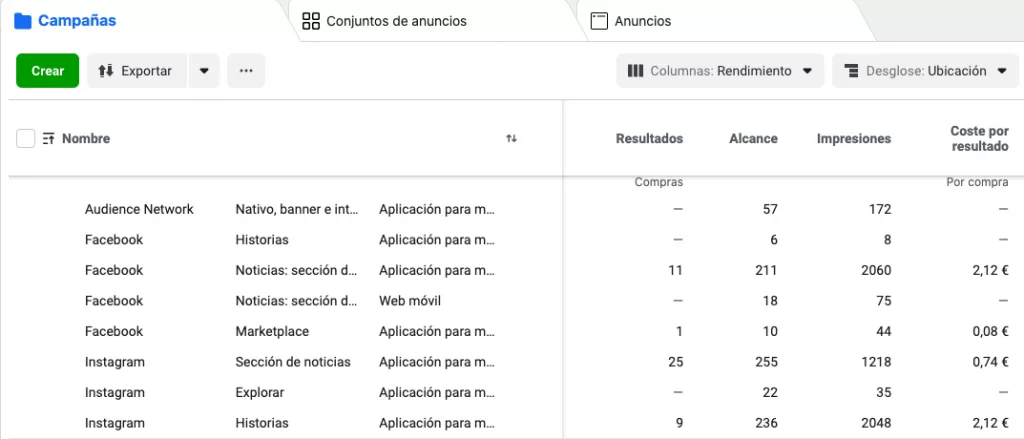
You can now see how your ad set was displayed across different placements. Facebook also shows whether the placement appeared on desktop, in a mobile app, or on mobile web.
If you are unsure which placement to choose, you can activate your campaign across all available placements for a short period. Thanks to the report breaking down results by placement, you will be able to make decisions that allow you to reduce your Facebook/Instagram advertising costs.