Google Shopping vs Performance Max: How to Decide in 2026
91% of PMax accounts cannibalize Shopping traffic. Data-backed guide to picking the right option for your budget.
In this article
91.45% of accounts running Performance Max have keyword overlap with their Search and Shopping campaigns (Optmyzr, 503 accounts, February 2025). When they compete on the same search terms, Search wins on conversion rate 84% of the time (Adalysis, 3,300 campaigns, 2025). Meanwhile, Google claims PMax drives 18% more conversions at the same CPA.
So who’s right? Both. They’re just measuring different things. This guide helps you decide when to use standard Shopping, when to go with PMax, and when to combine both, using real data and a decision framework based on your budget.
In 30 seconds:
- 91% of PMax accounts have keyword overlap with Search/Shopping (Optmyzr, 2025)
- On overlapping terms, Search wins on conversion rate 84% of the time (Adalysis, 2025)
- Google says PMax drives 18% more conversions at the same CPA (Google, 2025)
- PMax adoption dropped from 82% to ~76% between May 2024 and early 2025 (Smarter Ecommerce, 2025)
- Accounts allocating 50%+ of budget to PMax reach 625% ROAS (Smarter Ecommerce, 2025)
What’s the Difference Between Standard Shopping and Performance Max?
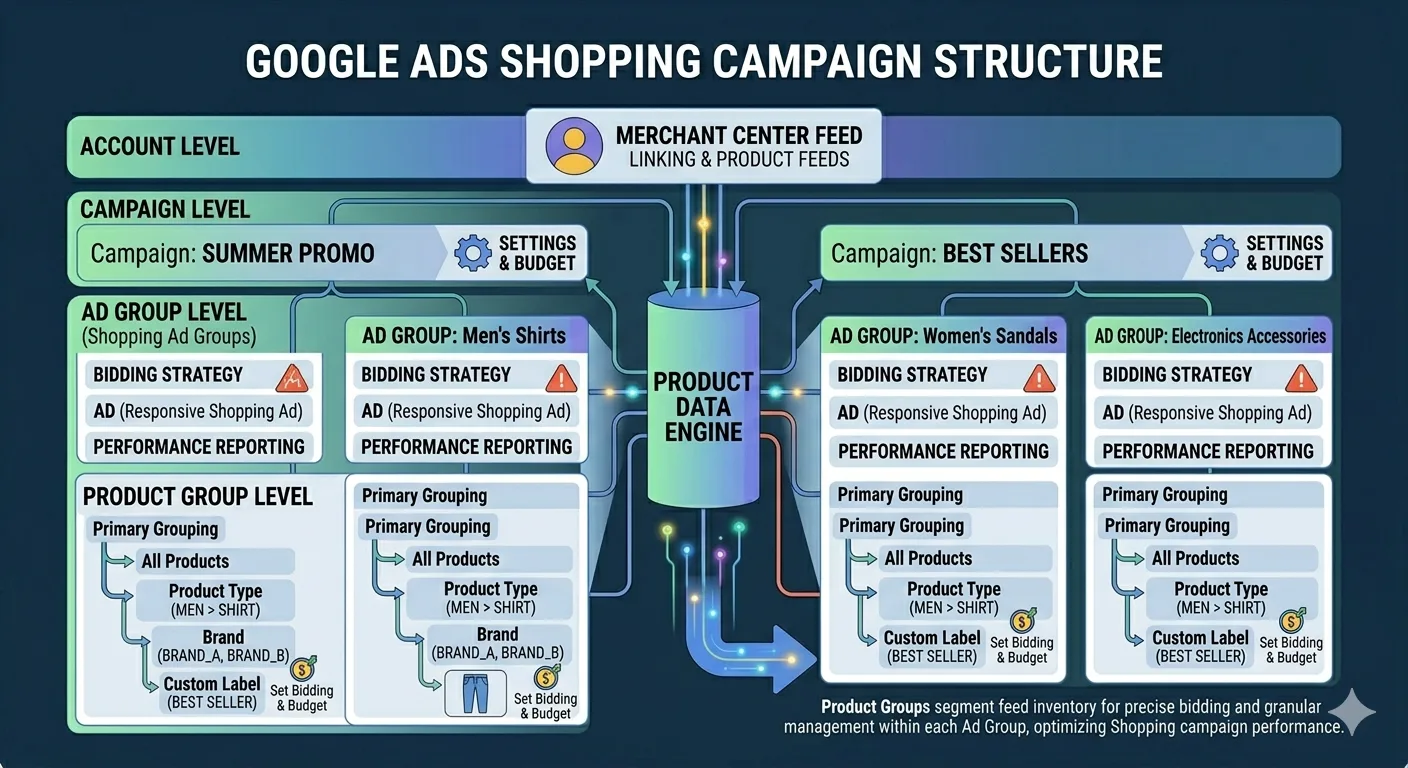
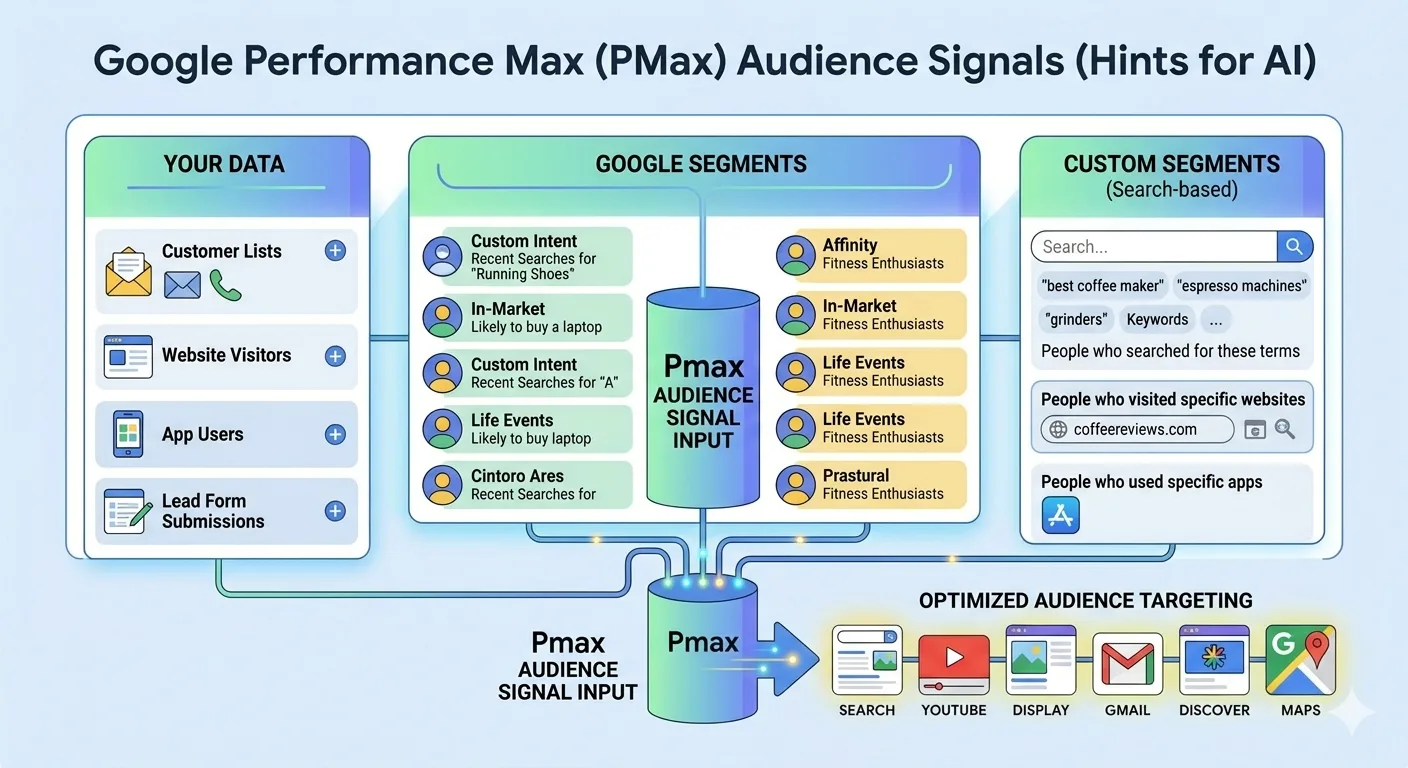
Standard Shopping gives you full control. You pick which products to advertise, at what price, with what priority, and which search terms trigger your ads. It only runs on Google Search and the Shopping tab. PMax takes your product feed and distributes it across every Google channel: Search, Shopping, YouTube, Display, Gmail, Maps, and Discover. More reach, less control.
The real difference isn’t about channels. It’s about philosophy. Standard Shopping is like driving a manual transmission: you know exactly what the engine is doing at every moment. PMax is a self-driving car: you get there faster when the road is clear, but if something goes wrong you can’t grab the wheel.
In practice, most of PMax spend goes to feed-based Shopping ads. That means even though PMax is “multichannel,” the bulk of your budget ends up on the same Shopping ads you’d get with a standard campaign. The difference is who decides how it’s distributed.
For a deeper look at how PMax works, check out the complete Performance Max guide for ecommerce.
When Is Standard Shopping Better Than PMax?
On overlapping queries, Search and standard Shopping beat PMax in CTR 65% of the time and in conversion rate 84% of the time (Adalysis, 3,300 campaigns, 1.2 million search terms, 2025). The takeaway: standard Shopping wins where control matters.
Standard Shopping works better when:
- Your budget is under $3,000/month. PMax needs volume to learn. With fewer than 30-50 conversions per month, the algorithm doesn’t have enough data to optimize and ends up spending on irrelevant searches. Standard Shopping protects every dollar.
- You sell niche products with high margins. The more specific your catalog, the less sense it makes to give Google total freedom. If you sell vintage film cameras or artisan luxury goods, the search term report in standard Shopping is your best tool.
- You need full search term report visibility. Standard Shopping shows you exactly which searches trigger your ads. PMax improved transparency in 2025, but it’s still far from the level of detail standard Shopping provides.
- Your brand campaigns need protection. 91.45% of PMax accounts have overlap with Search (Optmyzr, 2025). That includes branded searches, where PMax takes credit for conversions that would’ve happened anyway.
When I open a new account with a tight budget and find PMax as the only campaign, it’s almost always the root cause. The budget gets spread across too many channels without enough volume for any of them to work properly.
When Is Performance Max the Best Choice?
Google reports that advertisers using PMax get an average 18% more conversions at the same CPA (Google, April 2025). That figure comes from over one million active accounts. It’s real. But there are conditions.
PMax works well when:
- Your budget exceeds $5,000-10,000/month. More budget means more data for the algorithm. Accounts that allocate over 50% of their budget to PMax achieve a 625% ROAS (Smarter Ecommerce, 4,000+ campaigns, 2025).
- You have a large catalog (100+ products). PMax shines with big feeds because it can identify product-audience combinations you’d never find manually. KEH Camera switched from standard Shopping to PMax and saw a 76.3% increase in ad revenue with an average ROAS of 9.93x (Inflow, 2023).
- You want YouTube and Display reach without managing separate campaigns. If your team doesn’t have time to build Display remarketing and YouTube video campaigns, PMax bundles everything into one.
- Your Smart Bidding is already well calibrated. PMax needs a solid conversion history. Without that foundation, it won’t perform.
What I see in high-budget accounts: PMax isn’t magic. The accounts where it works well have precise tracking (Enhanced Conversions enabled), complete negative keyword lists at the account level, and at least 100 monthly conversions.
The Decision Framework: What to Use Based on Your Budget
No article I’ve seen gives concrete numbers. Here are mine, based on what I see across ecommerce accounts:
| Monthly budget | Recommendation | Why |
|---|---|---|
| Under $3,000 | Standard Shopping only | Not enough volume for PMax to learn. Every dollar counts. |
| $3,000-$10,000 | Hybrid: Shopping as primary, PMax for exploration | Shopping protects your profitable traffic. PMax with 20-30% of the budget looks for new reach. |
| Over $10,000 | PMax-led hybrid | PMax handles the volume. Standard Shopping protects brand and top-performing products. |
This framework isn’t universal. It depends on your product margins, catalog size, and account maturity. But it’s a more useful starting point than “it depends” or “test both.” For the full ecommerce Google Ads context, see the complete Google Ads ecommerce guide.
How to Build a Hybrid Strategy That Actually Works
Most advertisers already use PMax alongside other campaign types. The “hybrid” approach isn’t a new idea. What most accounts lack is a clear architecture.
Step 1: Protect your brand. Create a Search campaign with exact match on your brand keywords. This prevents PMax from claiming credit for conversions that would’ve come in anyway. It’s the number one mistake I find in audits.
Step 2: Standard Shopping for your best performers. Your top 20-30 products by ROAS go into a standard Shopping campaign with high priority. Full bid control and complete search term visibility.
Step 3: PMax for the rest of the catalog. The long tail, new products without history, and categories where you want to discover new demand go into PMax. Make sure to exclude the products in your standard Shopping campaign to avoid internal competition.
Step 4: Account-level negatives. Since 2025, Google lets you add negative keywords at the account level that apply to PMax. Use this to block irrelevant queries and branded searches you already cover with Search.
For a deeper dive into structuring your Shopping campaigns, check the Shopping campaign structure guide.
When to Stop Using PMax and Switch Back to Standard Shopping
Nobody talks about this. But there are clear signs PMax isn’t working in your account:
- Your ROAS drops more than 20% for 4 consecutive weeks without changes to the feed or seasonality. PMax can enter negative spirals where the algorithm chases volume at the expense of profitability.
- The search term report shows over 30% irrelevant queries. If PMax is triggering your ads for searches that have nothing to do with your products, the algorithm hasn’t learned.
- Assisted conversions from PMax are sky-high but direct conversions are low. This usually means PMax is taking credit for conversions that would’ve happened regardless (especially from Display and YouTube).
- Your daily budget doesn’t reach 3x your target CPA. Google recommends this minimum ratio. If your target CPA is $20 and your daily budget is $40, PMax doesn’t have room to optimize.
PMax adoption dropped from 82% to 76% between May 2024 and early 2025 (Smarter Ecommerce, 4,000+ campaigns). Not everyone who left PMax made the right call, but the trend shows that many advertisers realized PMax wasn’t the universal solution they’d expected.
Want Me to Audit Your Google Ads Account?
If you’re not sure whether your Shopping and PMax structure is right, I can take a look. In 30 minutes I’ll tell you what I’d change.
Book a free consultation - 30 min - No commitment
FAQ: Shopping vs Performance Max
Is PMax always better than standard Shopping?
No. Google reports 18% more conversions with PMax (Google, 2025), but that figure includes all channels. On overlapping searches, standard Shopping wins on conversion rate 84% of the time (Adalysis, 2025). PMax is better for multichannel reach; standard Shopping is better for control and efficiency on Search.
Can I run standard Shopping and PMax at the same time?
Yes, and most advertisers do exactly that. The key is clean separation: standard Shopping for top performers and brand terms, PMax for the long tail and new demand discovery. Exclude your standard Shopping products from PMax to avoid internal competition.
What’s the minimum budget PMax needs to work?
PMax needs a daily budget of at least 3x your target CPA to exit the learning phase. In practice, that means at least $3,000-5,000/month for most ecommerce businesses. Below that threshold, standard Shopping usually delivers better results.
Does PMax cannibalize my Search and Shopping campaigns?
In most accounts, yes. 91.45% of PMax accounts have keyword overlap with Search (Optmyzr, 2025). You can mitigate this with account-level negative keywords (available since 2025) and by protecting your brand campaigns with exact match in Search.
What about the search term report in PMax?
PMax improved search term visibility in 2025, but it’s still less transparent than standard Shopping. You can’t see every term that triggers your ads or control at a granular level which searches to exclude directly in the campaign. If transparency is critical for your business, standard Shopping is more reliable.
Sources
- Optmyzr. Is Performance Max cannibalizing your Search campaigns? https://www.optmyzr.com/blog/is-pmax-cannibalizing-search/. February 2025.
- Adalysis. Is Performance Max cannibalizing your Search ads? A deep dive into search term overlap. https://adalysis.com/blog/is-performance-max-cannibalizing-your-search-ads-a-deep-dive-into-search-term-overlap/. 2025.
- Google. New ways to multiply your results with Performance Max. https://blog.google/products/ads-commerce/performance-max-new-features/. April 2025.
- Smarter Ecommerce. State of Performance Max campaigns 2025. https://smarter-ecommerce.com/blog/en/google-ads/state-of-performance-max-campaigns-2025/. 2025.
- Inflow. KEH Camera Performance Max case study. https://www.goinflow.com/blog/performance-max-case-study/. 2023.

Could your ad campaigns
perform better?
30 minutes to review your situation and tell you exactly what I would change. No pitch, no sales proposal.